
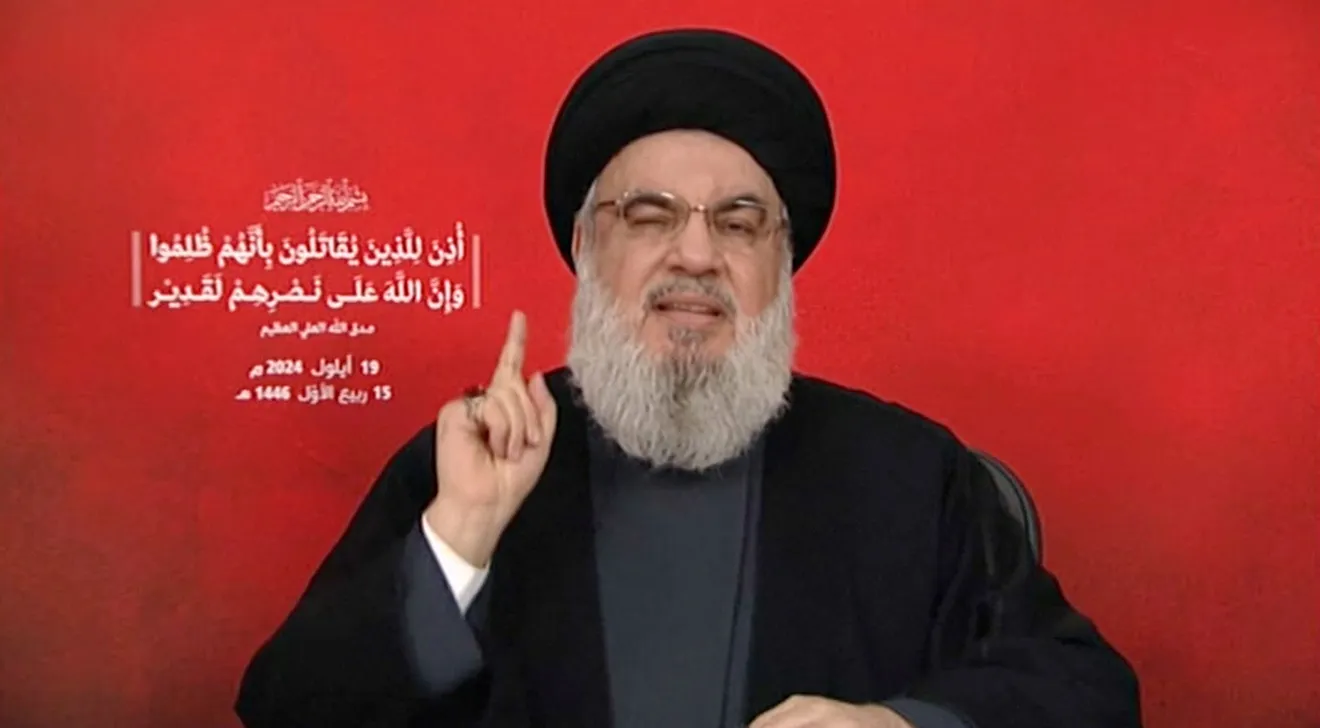


Hassan Nasrallah, the long-standing and polarizing leader of Hezbollah, was killed on Friday in an Israeli airstrike, according to the Israeli Defense Forces (IDF).
In a statement released Saturday, the IDF announced, “Nasrallah, the leader of the Hezbollah terrorist organization and one of its founding members, was neutralized by our forces.”
The statement added that, “Following precise intelligence,” Israeli fighter jets “carried out a targeted strike on Hezbollah’s Central Headquarters, which was concealed underground beneath a residential building in the Dahieh area of Beirut.”
An Underground Meeting and a Massive Crater
The targeted strike on Israel’s most formidable neighboring adversary has sent shockwaves through the region, marking a political upheaval that raises the risk of an armed retaliation against Israeli and U.S. targets by Iran and its proxies in Iraq, Syria, and Yemen.
“This is monumental,” remarked Mohamad Bazzi, director of the Kevorkian Center for Near East Studies at New York University. “It represents a significant setback for Hezbollah and a major blow to Iran.”
Iranian Supreme Leader Ali Khamenei declared that Nasrallah’s blood “will not go unpunished.”
According to Iranian media reports on Saturday, a senior member of Iran’s Revolutionary Guards was also killed in the airstrike.
Nasrallah was a pivotal figure in the Middle East, leading tens of thousands of fighters and equipped with missiles provided by Iran, the Shia Islamist movement’s benefactor. Hezbollah effectively governs southern Lebanon and its nearly 1 million residents, operating independently of the fragile Lebanese government.
“The strike was conducted while Hezbollah’s senior chain of command were operating from the headquarters and advancing terrorist activities against the citizens of the State of Israel,” the Israeli statement said.
Friday’s airstrike on Dahiyeh shook Beirut. A security source in Lebanon told Reuters the attack − a quick succession of massively powerful blasts − had left a crater more than 20 yards deep. It was unclear how many people were killed.
On Saturday, additional airstrikes targeted Dahiyeh and other regions of Lebanon. Massive explosions illuminated the night sky, with more strikes occurring Saturday morning, sending plumes of smoke rising over the city.
The death of Hezbollah’s longtime leader followed a week of Israeli operations aimed at crippling the militant group’s military capabilities. These actions were intended to enable the safe return of 60,000 residents in northern Israel to their homes, which had been evacuated due to months of rocket fire originating from across the Lebanese border.
For almost a year, the Iran-backed militant group has intensified firing of rockets into northern Israel. Tensions on that border have increased since the October 7 attack by Hamas on Israel that killed 1,200 people. Israel responded by launching military strikes on Gaza that have killed about 40,000 Palestinians, according to the Hamas-run Gazan Health Ministry.
U.S. officials are concerned that a ratcheting up of tensions could lead to a broader regional conflict in the Middle East and have been trying to negotiate a cease-fire.
More than 1,500 people have been killed in Lebanon in the last week, and more than 90,000 displaced, on top of 100,000 forced to flee since October.
Among supporters, Nasrallah has been lauded for standing up to Israel and defying the United States. To enemies, he was head of a terrorist organization and a proxy for Iran’s Shia Islamist theocracy in its tussle for influence in the Middle East.
“No doubt, he is a particularly important figure,” Bazzi told USA TODAY. “He’s very charismatic, an excellent orator.”
Still, Bazzi said, “His star has fallen in the Middle East since Hezbollah’s involvement in the Syrian civil war,” when Hezbollah fighters were key to the survival of Bashar al Assad’s brutal government.
Nasrallah’s regional influence has been on display over nearly a year of conflict ignited by the Gaza war, as Hezbollah entered the fray by firing on Israel from southern Lebanon in support of its Palestinian ally Hamas, and Yemeni and Iraqi groups followed suit, operating under the umbrella of an Iran-led “Axis of Resistance.”
“We are facing a great battle,” Nasrallah said in an Aug. 1 speech at the funeral of Hezbollah’s top military commander, Fuad Shukr, who had been killed in an Israeli strike.
Yet when thousands of Hezbollah members were injured and dozens killed, when their pagers and walkie-talkies exploded in an apparent Israeli attack last week, that battle began to turn against his group.
Responding to the attacks on Hezbollah’s communications network in a Sept. 19 speech, Nasrallah vowed to punish Israel.
“This is a reckoning that will come, its nature, its size, how and where? This is certainly what we will keep to ourselves and in the narrowest circle even within ourselves,” he said.
He has not given a broadcast address since then.
Israel has meanwhile dramatically escalated its attacks, killing several senior Hezbollah commanders in targeted strikes and unleashing a massive bombardment in Hezbollah-controlled areas of Lebanon, which has killed hundreds of people.
Israel said Friday’s strike also killed Ali Karki, who it identified as the commander of Hezbollah’s southern front, and other leaders.
Iran on Friday accused Israel of using U.S.-made “bunker buster” bombs in the attack.
‘Serious security breaches’
“There have clearly been serious security breaches in Hezbollah,” Bazzi said. “It begs the question of how and why he was moving around at this point.”
“This is severe, decapitating in some ways.” Still, Bazzi added, “They are also set up − Nasrallah has made this point himself − as an organization that will continue as leaders get killed.”
Recognized even by his enemies as a charismatic orator, Nasrallah’s speeches were followed by friend and foe alike.
Wearing the black turban of a sayyed, or a descendent of the Prophet Mohammad, Nasrallah used his addresses to rally Hezbollah’s base but also to deliver carefully calibrated threats, often wagging his finger as he did so.
He became secretary general of Hezbollah in 1992 at 35, the public face of a once shadowy group founded by Iran’s Revolutionary Guards in 1982 to fight Israeli forces in southern Lebanon.
Israel killed his predecessor, Sayyed Abbas al-Musawi, in a helicopter attack. Nasrallah led Hezbollah when its guerrillas finally drove Israeli forces from southern Lebanon in 2000, ending an 18-year occupation.
Hezbollah and Israel fought to a standstill in a 2006 war.
(Source Collected : Reuters)