
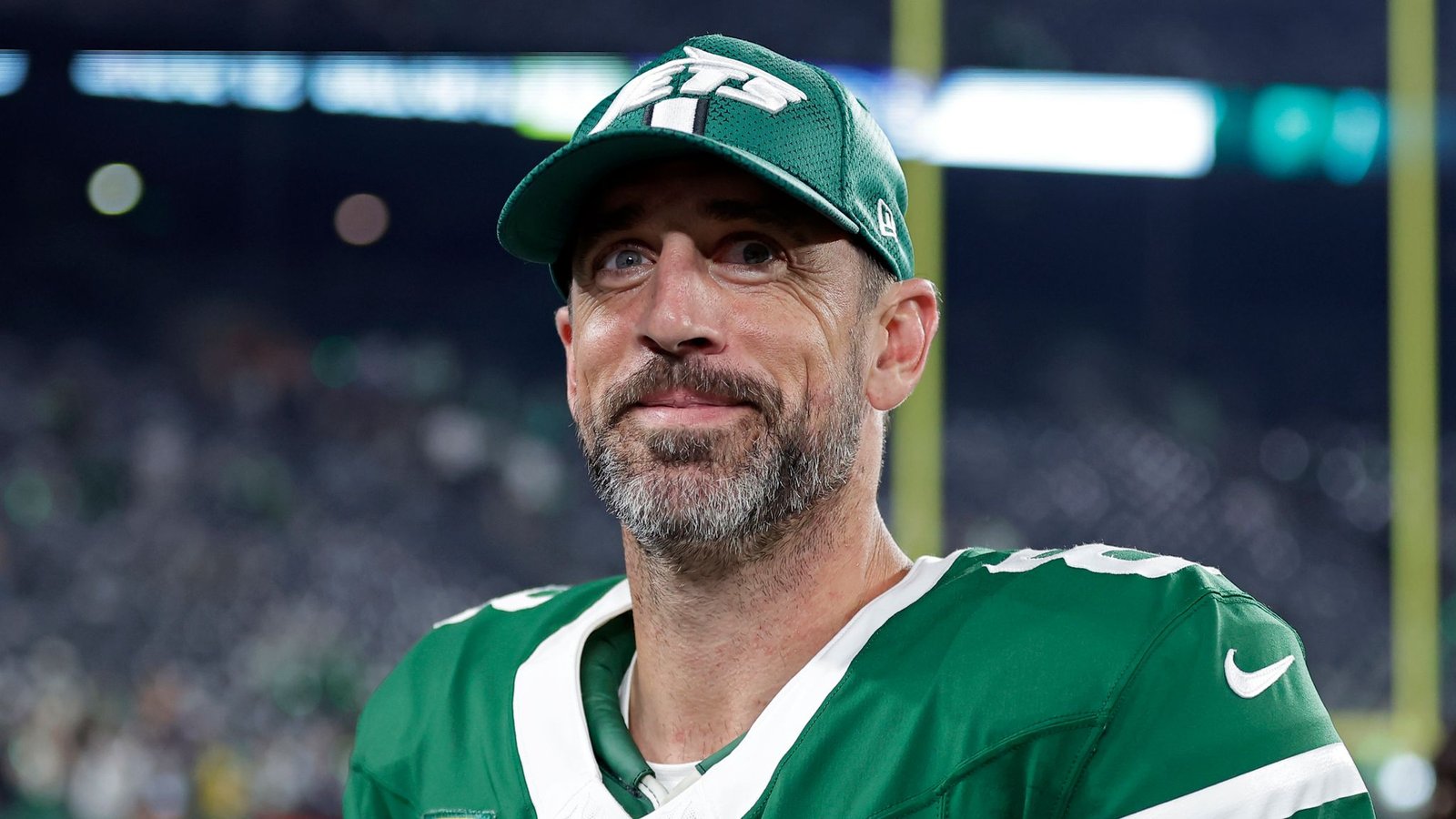


New York Jets quarterback Aaron Rodgers revealed that he suffered a low ankle sprain during the team’s 23-17 loss to the Minnesota Vikings in London on Sunday. Rodgers, who was helped off the field in the third quarter after a hard hit, returned to the game and played through the injury, showing resilience despite struggling to find his rhythm against a relentless Vikings defense.
Rodgers went down awkwardly after being hit on a third down incompletion, and for a moment, it appeared that the Jets might have to finish the game without their star quarterback. He needed assistance to leave the field, but returned after the Vikings were flagged for roughing Jets punter Thomas Morstead on the ensuing possession, giving New York a fresh set of downs. The veteran quarterback toughed it out for the remainder of the game but admitted afterward that the injury did affect his performance.
“It’s a low ankle sprain,” Rodgers told reporters in his post-game press conference. “It’s not great, but I’m going to keep playing through it. I’ve dealt with worse, and I’ll be ready for next week.”
Rodgers finished the game completing 29 of 54 passes for 244 yards, two touchdowns, and three interceptions. His uncharacteristic turnovers, coupled with the Jets’ struggles to protect him, contributed to a frustrating afternoon for New York. He was sacked three times and hit 11 times in total by the Vikings’ defense, which seemed to dial up the pressure as the game progressed.
Impact of the Injury
While Rodgers was able to finish the game, the ankle sprain could linger and impact his mobility moving forward. Known for his ability to extend plays and improvise under pressure, Rodgers’ effectiveness could be hampered if he’s unable to move comfortably in the pocket. The Jets’ offensive line, which has struggled with injuries of its own, will need to step up its protection schemes to keep Rodgers upright and limit further aggravation of the injury.
The Jets’ coaching staff has not indicated any plans to rest Rodgers in the upcoming weeks, with head coach Robert Saleh expressing confidence in the quarterback’s toughness. “Aaron’s a competitor. He’s dealt with these kinds of things before, and he’s going to fight through it,” Saleh said. “We’ll monitor him throughout the week, but right now, we expect him to be out there for us.”
A Rough Day in London
The loss to the Vikings dropped the Jets to 2-3 on the season, a disappointing start for a team that entered the year with high expectations following Rodgers’ arrival. His three interceptions on Sunday—one of which was returned for a touchdown—marked a low point for the offense, which has yet to find a consistent rhythm. Despite his struggles, Rodgers made it clear that he doesn’t view the injury as an excuse.
“I’m not going to blame the ankle for the mistakes I made out there,” Rodgers said. “It was a tough game, and I didn’t play up to the standard I set for myself.”
With the Jets set to return to MetLife Stadium to face the division rival Buffalo Bills on Monday Night Football next week, the pressure will be on Rodgers and the offense to deliver a strong performance. The Bills’ defense, ranked among the league’s best, will be a challenging test, especially if Rodgers’ mobility is compromised.
What’s Next for the Jets?
The focus for the Jets this week will be on keeping Rodgers healthy and addressing the protection issues that plagued them in London. The team has already dealt with injuries on the offensive line, and any additional strain on Rodgers could further derail their season. Saleh and offensive coordinator Nathaniel Hackett will likely emphasize quicker releases and shorter routes to reduce the hits Rodgers takes.
As Rodgers looks to recover, the Jets are hopeful that he can bounce back and lead the team to a much-needed win. “We’ve got a long season ahead,” Rodgers said. “I’m not worried about the ankle. We’ll get it right and be ready to go.”