
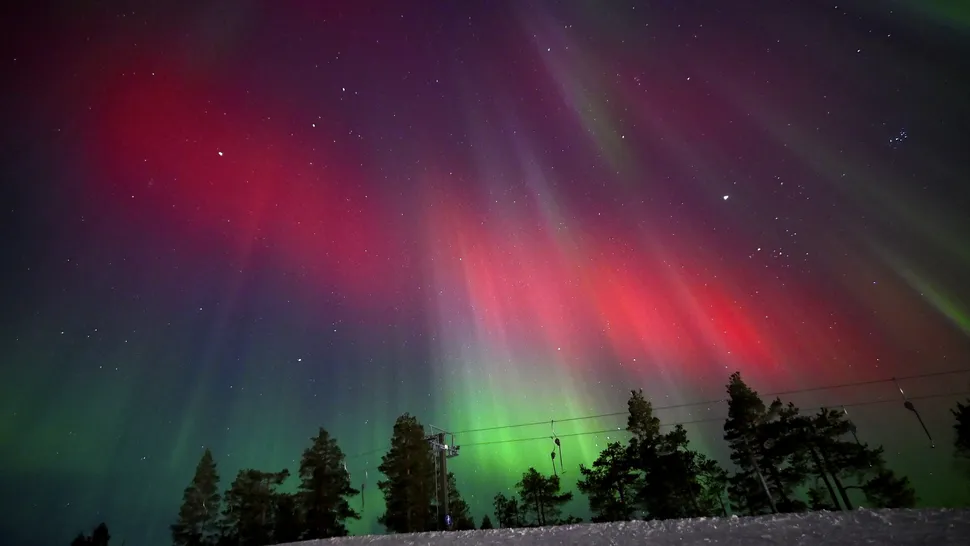


The New Year began with a dazzling celestial display as powerful solar storms triggered vibrant auroras across regions of the central United States and Europe. The stunning phenomenon, typically confined to higher latitudes, stretched farther south than usual, giving millions an unexpected glimpse of the northern lights.
Auroras Reach Uncommon Latitudes
On the night of December 31 into January 1, reports of shimmering auroras came from areas as far south as Nebraska, Iowa, and Pennsylvania in the United States. In Europe, the northern lights graced skies over Germany, the Netherlands, and the UK, captivating observers with hues of green, purple, and pink.
This rare visibility was due to heightened geomagnetic activity stemming from a series of solar storms. The National Oceanic and Atmospheric Administration (NOAA) classified the storm as a G3 (strong) geomagnetic event, which occurs when charged particles from the Sun interact with Earth’s magnetic field.
A Spectacular Start to 2025
For many, the auroras added an enchanting element to New Year’s celebrations. Social media platforms were flooded with photographs and videos of the natural light show, with users expressing awe at the rare phenomenon.
“It was like the heavens opened up to welcome the New Year,” said one observer from Minnesota. Another in Germany described the experience as “magical and surreal,” noting that they had never seen the northern lights so vividly in their region.
Scientific Perspective
Solar storms are a result of eruptions on the Sun’s surface, such as solar flares or coronal mass ejections (CMEs). These events release bursts of charged particles that travel through space and sometimes collide with Earth’s magnetosphere, sparking auroras.
According to experts, the solar activity responsible for this event is linked to an active sunspot cluster that has been generating frequent eruptions. Scientists anticipate increased solar activity in the coming months as the Sun approaches the peak of its 11-year solar cycle.
“This is just a taste of what we might expect in 2025,” said a NOAA spokesperson. “Auroras could become more frequent and intense as solar activity continues to ramp up.”
Viewing Tips for Future Displays
Experts recommend finding dark, open areas away from city lights to fully enjoy auroral displays. Checking aurora forecasts, which rely on data from NOAA’s Space Weather Prediction Center, can also help enthusiasts plan their viewing.
The phenomenon serves as a reminder of the Sun’s profound influence on Earth and the beauty that cosmic interactions can create.
A Memorable Start to the Year
As the northern lights lit up skies across unexpected regions, they provided an unforgettable start to 2025 for stargazers and casual observers alike. With more solar activity expected in the near future, many are already looking forward to the next opportunity to witness this awe-inspiring spectacle.