
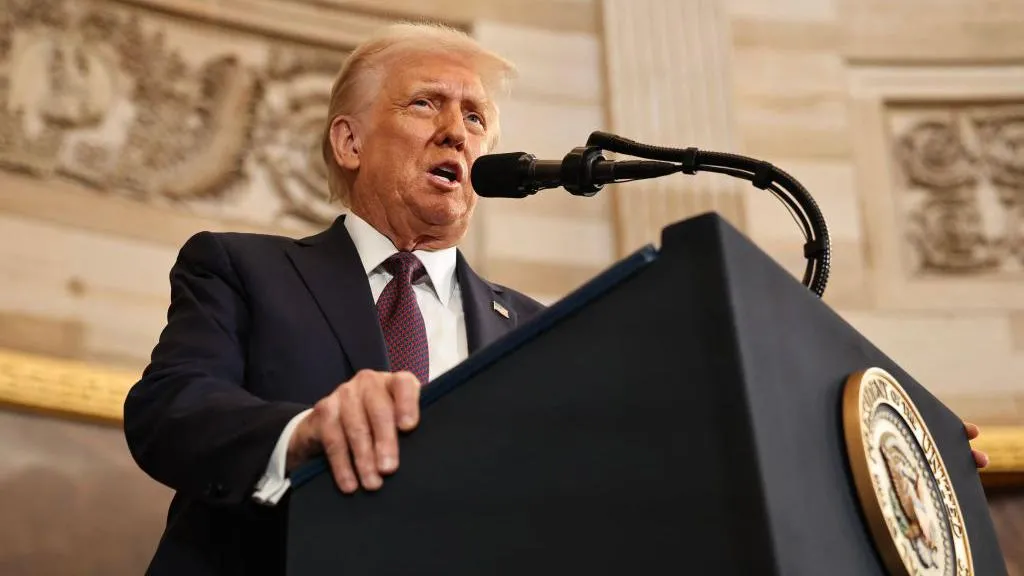


President Donald Trump has signed an executive order aiming to end birthright citizenship for children born in the United States to undocumented immigrants. This controversial move is part of a broader immigration overhaul that includes ten executive actions addressing border security, deportations, and refugee resettlement.
Challenging the 14th Amendment
The executive order seeks to reinterpret the 14th Amendment, which has long granted citizenship to all individuals born on U.S. soil, regardless of their parents’ immigration status. Legal scholars widely regard this reinterpretation as unconstitutional, setting the stage for significant legal battles.
An administration official confirmed that the policy would apply to future births and that implementation details are still being finalized. “The president is taking decisive action to protect our borders and ensure fairness in our immigration system,” the official stated, emphasizing the administration’s commitment to stricter immigration enforcement.
Critics argue that such a reinterpretation undermines the Constitution and disregards established legal precedent. Omar Jadwat, director of the ACLU’s Immigrants’ Rights Project, stated, “This executive order is not only illegal but an attack on the fundamental values that define America.”
Broader Immigration Actions
The executive order is one of ten actions aimed at reshaping U.S. immigration policy. Among other measures, the administration plans to:
- Ramp up deportations by accelerating the removal of undocumented immigrants.
- Suspend refugee resettlement, citing national security concerns.
- Expand detention facilities to manage an anticipated increase in border apprehensions.
The orders reflect Trump’s hardline stance on immigration, which has been a cornerstone of his presidency and 2024 campaign.
Legal and Political Ramifications
Trump’s attempt to end birthright citizenship is expected to face immediate legal challenges. Constitutional experts argue that the 14th Amendment, ratified in 1868, explicitly guarantees citizenship to anyone born on U.S. soil, regardless of parental status.
“This move is a direct affront to the Constitution and an egregious abuse of executive power,” said Erwin Chemerinsky, dean of Berkeley Law.
The policy also has political implications, with opponents accusing Trump of using immigration as a divisive campaign issue. Democratic leaders, including Senate Majority Leader Chuck Schumer, have condemned the order, calling it “a desperate and unconstitutional attack on immigrant communities.”
Advocates and Supporters
Despite widespread criticism, Trump’s base has largely welcomed the move as a necessary step to curb illegal immigration and uphold American sovereignty. Mark Krikorian, executive director of the Center for Immigration Studies, praised the decision, stating, “Ending birthright citizenship is long overdue. It’s a loophole that has been exploited for decades.”
Impact on Families
If implemented, the policy could have far-reaching consequences for families with undocumented parents. Immigration advocates warn it would create a generation of stateless children and further marginalize immigrant communities.
Maria Gonzalez, an undocumented immigrant from El Salvador, expressed fear for her unborn child. “My baby was supposed to have a chance at a better future here. Now, I don’t know what will happen,” she said.
A Long Legal Battle Ahead
Experts predict that legal challenges will quickly tie up the executive order in courts, potentially delaying implementation indefinitely. The Supreme Court may ultimately have to decide the issue, which could redefine the scope of the 14th Amendment.
As the nation braces for the legal and social ramifications, Trump’s executive order on birthright citizenship underscores the administration’s commitment to reshaping U.S. immigration policy, even in the face of significant opposition.