
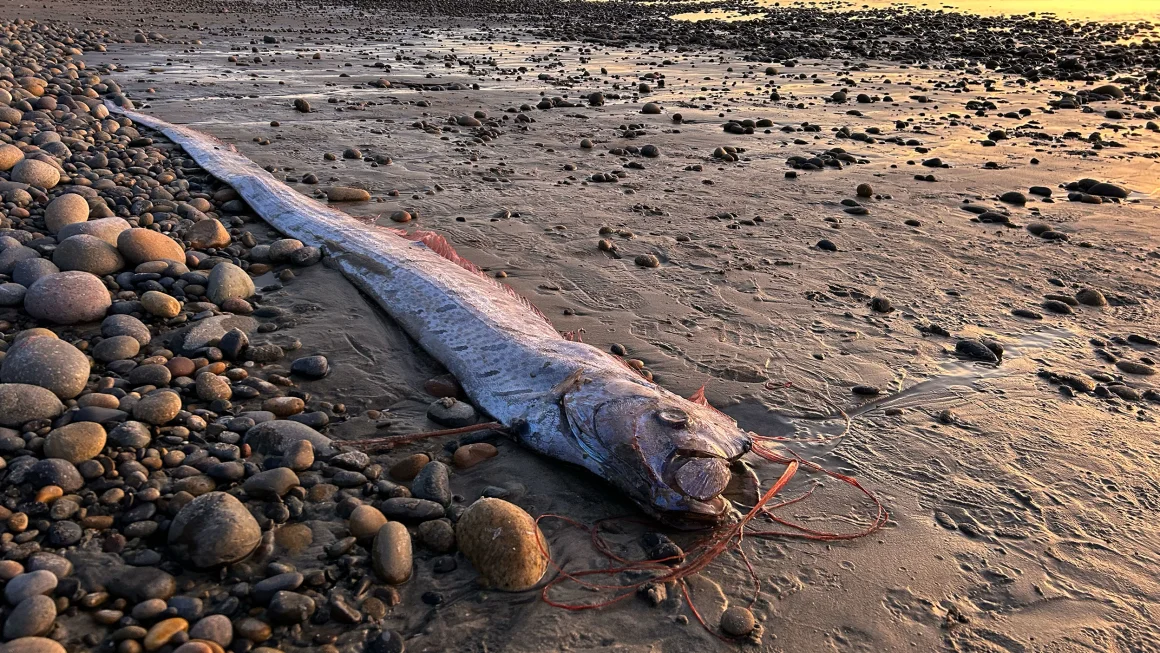


A rare and mysterious deep-water oarfish, often associated with myths of impending disaster, was discovered on Grandview Beach in Encinitas, California, on November 6. Measuring nine feet in length, the specimen marks California’s third oarfish sighting in three months and only the 22nd recorded in the state over the last century.
The remarkable find was made by Alison Laferriere from the Scripps Institution of Oceanography, according to a Facebook post by the institution. The deceased oarfish was retrieved by NOAA Fisheries Service and transported to the Southwest Fisheries Science Center for further study.
“We took samples and froze the specimen awaiting further study and final preservation in the Marine Vertebrate Collection,” explained Ben Frable, the collection’s manager, in the social media post.
The oarfish, also known as the “doomsday fish,” has fueled myths for centuries. Japanese folklore suggests that sightings near the shore are harbingers of earthquakes and tsunamis. Historical accounts, like the discovery of numerous oarfish on Japan’s coastline shortly before the devastating 2011 earthquake, have bolstered this belief. However, a 2019 GeoScience study found no scientific evidence linking oarfish appearances to seismic activity.
Living in the mesopelagic zone—up to 3,000 feet below the ocean’s surface—oarfish are seldom seen alive. These “sea serpents” are known for their long, ribbon-like bodies, which can grow up to 30 feet. Their elusive nature and deep-sea habitat make them one of the least understood marine species.
The recent Encinitas discovery follows two earlier sightings in Southern California. In August, a 12-foot oarfish washed ashore in La Jolla Cove, near underwater canyons that bring deep-sea conditions closer to the coast. In September, a more degraded specimen was found in Huntington Beach.
“These sightings offer a rare opportunity to gather fresh samples for genomic analysis,” said Dahiana Arcila, a marine biologist and curator at Scripps. She noted that studying these specimens can provide valuable insights into the evolutionary traits that enable oarfish to survive in extreme environments.
Scientists are still investigating why these deep-sea creatures occasionally surface and die. Frable suggested that changes in ocean conditions, such as recent red tides and Santa Ana winds, might play a role. “It may have to do with changes in ocean conditions and increased numbers of oarfish off our coast,” he said, adding that the exact causes are still unknown and likely influenced by multiple factors.
This latest specimen is now part of the Marine Vertebrate Collection at Scripps, one of the world’s largest repositories of deep-sea fish. Researchers hope the oarfish will shed light on its biology, anatomy, and life history, helping unravel the mysteries of this enigmatic species.
As sightings of oarfish remain rare, each discovery provides a unique opportunity for scientific exploration, dispelling myths while uncovering the realities of life in Earth’s least explored waters.