
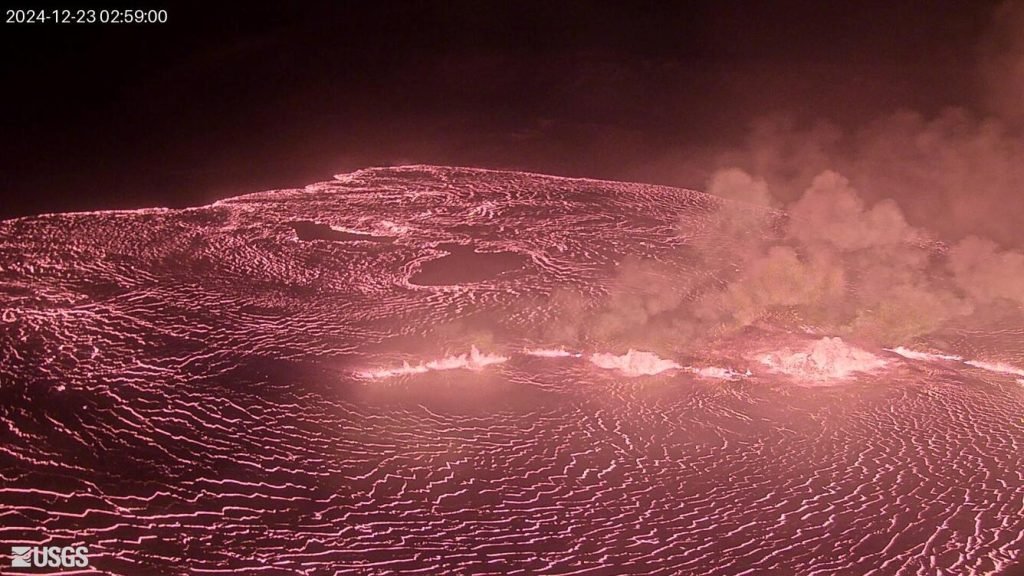


Hawai‘i’s Kīlauea volcano, one of the most active volcanoes in the world, began erupting early Monday within the Halemaʻumaʻu crater and summit caldera at Hawai‘i Volcanoes National Park. While initial alerts raised concerns for local communities, officials now report that the eruption has stabilized. As of 6:30 a.m., there are no immediate threats to infrastructure, offering relief to residents and visitors alike.
The eruption began around 2:30 a.m., accompanied by spectacular displays of lava fountains and glowing emissions visible from safe viewing areas within the park. The United States Geological Survey (USGS) Hawaiian Volcano Observatory (HVO) responded swiftly, monitoring the eruption’s activity and issuing warnings as a precaution. The immediate area saw heightened volcanic activity that raised the volcano alert level to “warning” and the aviation color code to “red” due to potential ash emissions.
However, as the eruption progressed, it became clear that the activity was confined to the summit caldera, significantly reducing potential risks to surrounding communities. By morning, the HVO lowered Kīlauea’s volcano alert level from “warning” to “watch,” reflecting decreased hazards. Similarly, the aviation color code was downgraded to “orange,” signaling minimal impact on air traffic.
Reduced Ashfall and Health Considerations
According to the National Weather Service (NWS) in Honolulu, the threat of falling volcanic ash has diminished significantly. Ashfall, initially a concern for populated areas of the Big Island, is now restricted to the immediate summit region. This reduction has allowed residents to breathe easier, both literally and figuratively.
Nevertheless, officials caution that volcanic activity can lead to vog (volcanic smog), which may affect localized air quality. Vog forms when sulfur dioxide gas from the eruption interacts with moisture and sunlight, producing fine particles that can irritate the eyes, throat, and lungs. The Hawai‘i Interagency Vog Information Dashboard provides guidelines on minimizing exposure, particularly for vulnerable populations such as individuals with respiratory conditions.
Park visitors are reminded to exercise caution and adhere to safety protocols while enjoying the natural spectacle. Restricted areas near the eruption site are off-limits, and designated viewing areas are strictly enforced to ensure public safety.
Kīlauea’s Eruption in Context
Kīlauea’s frequent eruptions make it one of the most closely monitored volcanoes on Earth. Its most significant eruption in recent history occurred in 2018, causing widespread damage, destroying over 700 homes, and reshaping the landscape of the Big Island. In contrast, the current eruption is localized, with no reported damage to infrastructure or private property.
Scientists at the HVO continue to monitor the situation using advanced technologies, including seismic data, thermal imaging, and gas emission analyses. These tools allow experts to track the volcano’s activity in real-time and provide timely updates to the public.
The Road Ahead
While the immediate danger has passed, experts caution that volcanic activity can change rapidly. Residents and visitors are urged to remain informed through official channels such as the HVO and the Hawai‘i Civil Defense Agency. Public awareness and adherence to safety measures remain key to ensuring that the eruption remains a harmless spectacle.
Kīlauea’s eruption, though dramatic, is a reminder of Hawai‘i’s unique and dynamic geological activity. As the volcano settles into a stable phase, scientists and locals alike reflect on the delicate balance between nature’s beauty and its unpredictable power.