
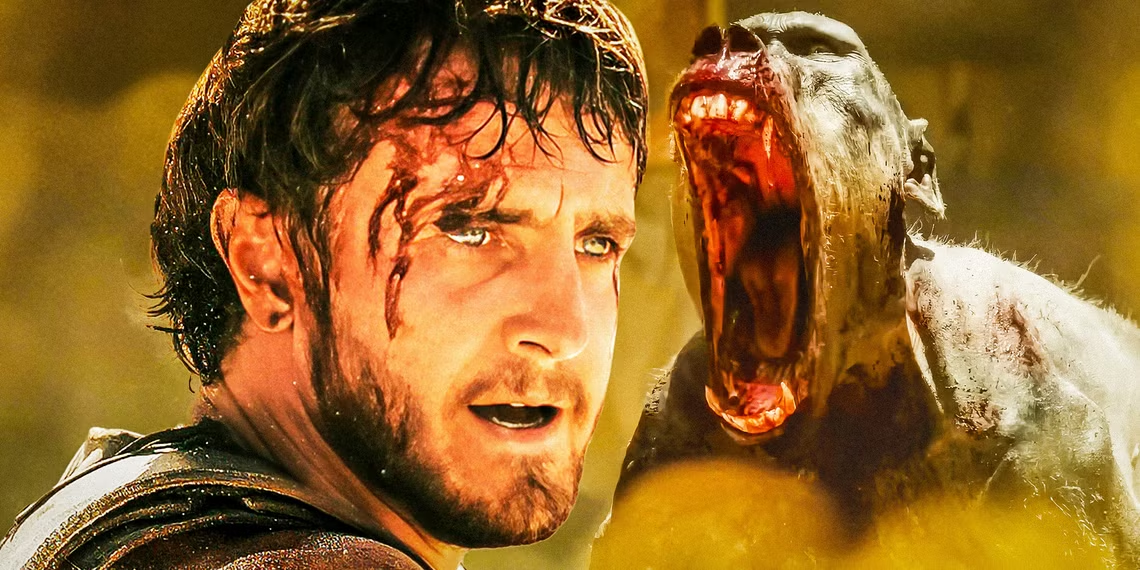


The much-anticipated sequel to Ridley Scott’s Gladiator has sparked intense debate among fans following the release of behind-the-scenes footage showcasing its heavy reliance on CGI. While the return to ancient Rome promises epic battles and grandeur, the inclusion of CGI sharks and monkeys in key sequences has left viewers both astonished and skeptical.
The original Gladiator (2000) is celebrated for its realistic portrayal of gladiatorial combat, relying on practical effects, expansive sets, and minimal CGI. In stark contrast, early glimpses of Gladiator 2 reveal a different approach. Reports suggest that the sequel introduces animals, including sharks in an underwater gladiatorial arena and monkeys in a jungle-themed battle, all rendered digitally. This departure from the grounded realism of its predecessor has drawn polarized reactions online.
Director Ridley Scott, known for his mastery of historical epics, defended the decision to use CGI animals. In a recent interview, he explained, “The world of gladiators wasn’t limited to sandy arenas. We’re exploring a broader narrative with spectacular environments, and CGI allows us to bring these wild, imaginative ideas to life.” Scott also emphasized that CGI was necessary for safety concerns and animal welfare, ensuring the production stayed ethical.
Despite these assurances, some fans remain unconvinced. Social media platforms erupted with mixed reactions. While some praised the ambitious direction, others criticized the execution. One Twitter user remarked, “Sharks and monkeys in Gladiator? It feels like a bizarre departure from the original’s gritty tone.” Conversely, another fan celebrated the fresh take, saying, “Why not push boundaries? The underwater scenes look stunning!”
Experts in visual effects also weighed in on the debate. CGI supervisor Marcus Keller, who worked on the film, stated, “Our goal was to ensure the animals felt as real as possible while enhancing the drama of the narrative. Every detail, from the sharks’ movements to the monkeys’ interactions, was meticulously crafted to blend seamlessly with live-action elements.” Keller revealed that the team used cutting-edge motion capture technology and consulted animal behaviorists to achieve authenticity.
However, early viewers of test screenings have reportedly had varied experiences. Some described the CGI as groundbreaking, while others found the digital animals distracting. This division has raised questions about whether the sequel can recapture the critical acclaim and box office success of its predecessor.
Gladiator 2 stars Paul Mescal, Pedro Pascal, and Denzel Washington in pivotal roles, with an expected release date in late 2024. The storyline reportedly focuses on Lucius, the nephew of Commodus from the original film, now navigating his own rise in a chaotic empire. As Ridley Scott expands his vision, the blend of CGI creatures with historical drama promises to create a unique cinematic experience.
Whether fans will embrace the bold use of CGI or yearn for the practical effects of the original remains to be seen. With Gladiator 2, Scott seems poised to push the boundaries of historical epics, proving that even 24 years after the original, there’s still room for innovation—and controversy.