
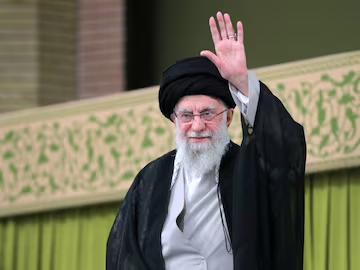


Iranian Supreme Leader Ayatollah Ali Khamenei has reportedly appointed his son, Mojtaba Khamenei, as his successor, sparking widespread speculation that he may abdicate his position before his death. These claims, sourced from unverified reports circulating within Iranian dissident networks and international media, highlight the opaque nature of succession planning within the Islamic Republic.
Mojtaba Khamenei, 54, holds significant influence in Iran’s political and military spheres, particularly through his close ties to the Islamic Revolutionary Guard Corps (IRGC). As a cleric, he lacks his father’s high-profile religious credentials but has reportedly played a pivotal role behind the scenes, shaping policies and consolidating power within the regime.
Opaque Succession Process
Iran’s constitution stipulates that the Assembly of Experts, an 88-member body of clerics, is responsible for selecting the Supreme Leader. However, Khamenei’s alleged move to preemptively secure his son’s succession could signal his intent to bypass formal procedures. Critics argue that such a decision undermines the assembly’s authority and reinforces concerns about nepotism and dynastic rule within the Islamic Republic.
The reports also suggest that Khamenei’s health may be a contributing factor. The 85-year-old leader has been rumored to suffer from various ailments, fueling speculation about an impending transition.
Mojtaba Khamenei’s Rising Influence
Mojtaba has long been seen as a shadowy figure in Iranian politics. Known for his low public profile, he wields considerable clout through his connections with the IRGC and his involvement in key decision-making processes, including Iran’s controversial nuclear program and its regional influence operations. His rise to power, however, could face resistance from factions within the government and among the Iranian populace, where dissatisfaction with economic conditions and political repression remains high.
Domestic and International Implications
A leadership transition could have profound implications for Iran’s domestic politics and its foreign relations. Domestically, Mojtaba’s succession might further alienate reformist factions and fuel public discontent, particularly among younger Iranians demanding greater political freedoms. Protests over economic mismanagement and human rights abuses have already demonstrated the regime’s fragility.
On the international stage, continuity in leadership under Mojtaba could mean an extension of Khamenei’s hardline policies, including Iran’s adversarial stance toward the West and its support for proxy groups across the Middle East. However, the transition could also offer a moment of potential recalibration, depending on Mojtaba’s approach to governance and diplomacy.
Lack of Official Confirmation
Iranian state media and officials have not commented on these reports, maintaining the regime’s characteristic silence on matters of succession. Analysts caution that until verified, such claims should be viewed critically, given the highly secretive nature of Iranian politics.
The prospect of a hereditary succession marks a potential turning point in the Islamic Republic’s history, raising questions about the legitimacy and future stability of its theocratic system. Whether Khamenei will formally abdicate or remain in power until his death, the unfolding narrative signals a critical juncture for Iran’s leadership.