

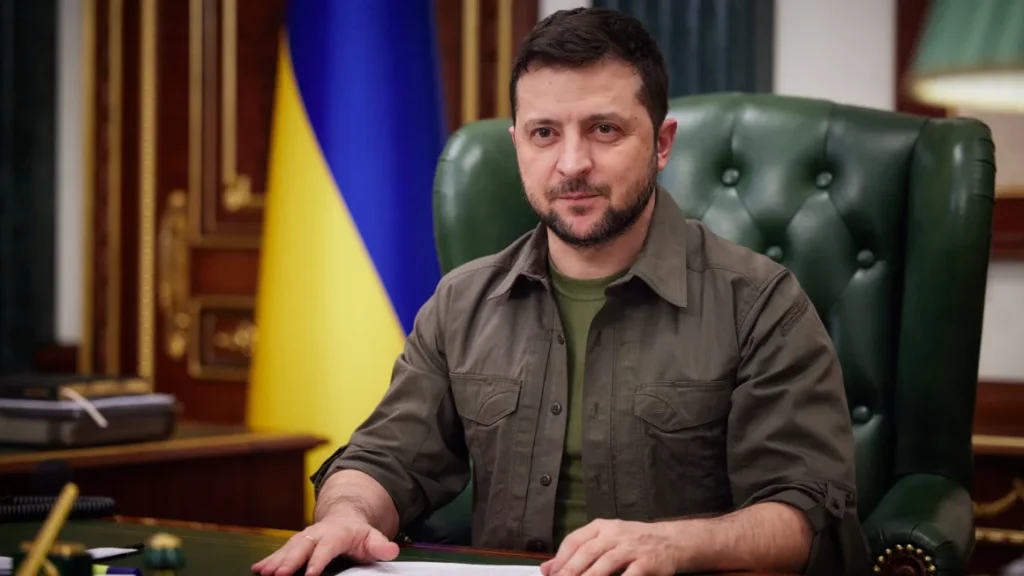
Ukrainian President Volodymyr Zelensky has denounced a recent call between German Chancellor Olaf Scholz and Russian President Vladimir Putin, warning it risks undermining efforts to isolate the Kremlin. Describing the conversation as opening a “Pandora’s box,” Zelensky criticized it for giving Putin exactly what he desires.
Ukraine Presidential Press Service/ABACA/Reuters
“This is exactly what Putin has been wanting for a long time: it is extremely important for him to weaken his isolation, Russia’s isolation, and to have normal negotiations that will not end in anything,” Zelensky said in his evening address.
The conversation on November 15 marked Scholz’s first interaction with Putin in nearly two years, a notable development amid tensions over Russia’s invasion of Ukraine. According to the German government, Scholz pressed Putin to withdraw troops and initiate talks with Kyiv for a “just and lasting peace.”
However, the Kremlin framed the call as initiated by Berlin and insisted any agreement must account for Russia’s security concerns and “new territorial realities.”
Domestic Politics in Germany
Zelensky and other European officials had urged Scholz to avoid engaging with Putin, suggesting the move was politically motivated. Facing a snap election on February 23, Scholz’s Social Democrats are grappling with criticism from populist parties demanding more diplomatic efforts to end the war, Reuters reported.
“The chancellor urged Russia to show willingness to enter talks with Ukraine with the aim of achieving a just and lasting peace,” a German government spokesperson stated. The spokesperson also emphasized Germany’s steadfast support for Ukraine in its defense against Russian aggression.
Zelensky dismissed the call’s utility, asserting that such engagements allow Russia to maintain its current policies without making meaningful changes.
“This [the call] made it possible for Russia to change nothing in its policy, to do nothing in essence, and this is exactly what led to this war,” Zelensky remarked.
Broader Implications for Allies
The timing of the call, shortly after Donald Trump’s election as the next U.S. president, has raised concerns among Western allies. Trump has signaled an intent to end the war swiftly, although he has not clarified his strategy, and has criticized the extent of Western aid to Kyiv.
“It sends a bad signal especially after Trump’s election,” one Western diplomat told Reuters. The source suggested Scholz might justify the call to his electorate as proof that dialogue with Putin yields no progress.
The Kremlin claimed Putin had reiterated Russia’s openness to energy deals, despite Germany cutting direct gas imports following the destruction of Baltic Sea pipelines in 2022.
Upcoming Briefings and War Conditions
Scholz plans to update Ukrainian officials, NATO, and EU leaders on the call’s outcome, German officials said. Both sides have agreed to remain in contact.
Meanwhile, Ukraine continues to face challenges on the battlefield, with shortages of arms and personnel amid Russian advances in the east. Zelensky has also accused North Korea of sending 11,000 troops to assist Russia, some of whom he claims have been engaged in combat in the Kursk region.
Since the war’s escalation in February 2022, Germany has provided Ukraine with €15 billion in military, humanitarian, and financial aid, making it Kyiv’s second-largest supporter after the U.S. The future of U.S. assistance remains uncertain following Trump’s election victory.
Scholz and Putin last spoke in December 2022, a period that marked a deep freeze in Russia-West relations after the invasion of Ukraine.