
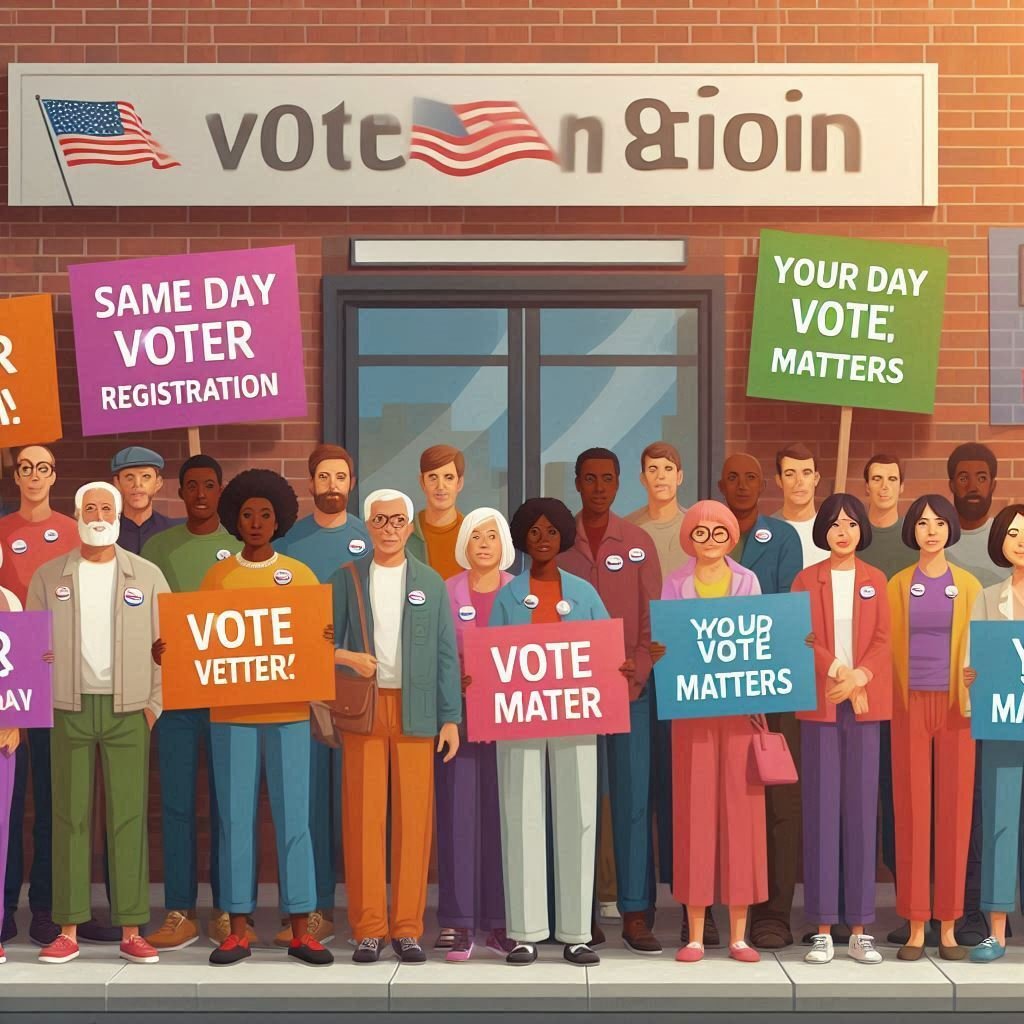


As Election Day approaches, millions of Americans are making final preparations to cast their ballots. For some voters, however, there’s a critical question: can they still register in time to vote on Election Day? Thanks to same-day voter registration (SDR) laws, many states have made it possible for eligible residents to register and vote on the same day, ensuring wider accessibility to the electoral process.
Same-day voter registration, often hailed as a vital step towards greater voter participation, allows people who may have missed traditional registration deadlines to still have their voices heard. SDR is offered in 22 states and the District of Columbia, making it a crucial option for those who want to engage but may have missed out on the initial registration window.
States that allow this practice include key battlegrounds such as Michigan, Wisconsin, and Nevada, where every vote has the potential to influence national outcomes. For new residents, people who missed registration deadlines, or those who are casting a ballot for the first time, SDR can be the difference between participating in democracy or sitting it out.
“This option is especially important in tight races,” said Larry Hansen, a political analyst based in Chicago. “Same-day registration offers a safeguard for eligible voters who may not have registered in advance, ensuring that they aren’t excluded from the democratic process.”
In states like California and Illinois, SDR has been implemented to encourage more diverse voter turnout. Advocates say it removes barriers for young voters, minorities, and transient populations, who often face logistical challenges in registering ahead of time. In Illinois, for example, young voters have increasingly embraced this opportunity. According to data from the Illinois State Board of Elections, SDR has significantly bolstered participation rates among Gen Z and Millennials, groups often underrepresented at the polls.
“Every eligible citizen should have the chance to vote,” said Emily Carter, a student from Chicago who took advantage of SDR during a previous election. “It feels empowering to know that even if I missed the registration deadline, I still have an option to participate.”
However, voters planning to register on Election Day need to be prepared. Most states require identification and proof of residency to complete the process. Requirements can vary, but a government-issued ID, a utility bill, or a rental agreement are often accepted. In states such as Minnesota and Wisconsin, people can also vouch for others, simplifying the process for those who may lack conventional forms of ID.
North Carolina stands as an exception to Election Day registration, as SDR is only available during the early voting period. Nevertheless, the state still ranks high in terms of accessibility due to its extended early voting options. The flexibility in states like North Carolina reflects a broader push to balance voter access with security in today’s polarized climate.
Notably, SDR has also raised questions about election integrity, a subject fiercely debated nationwide. Opponents argue that it may lead to potential issues with verifying voter eligibility. Supporters, however, contend that the benefits of inclusive voter access far outweigh these concerns.
This Election Day, same-day voter registration is expected to play a critical role in turnout, especially in competitive states. As voters continue to line up at the polls, SDR will offer a lifeline for those committed to participating in democracy, even at the last minute.