
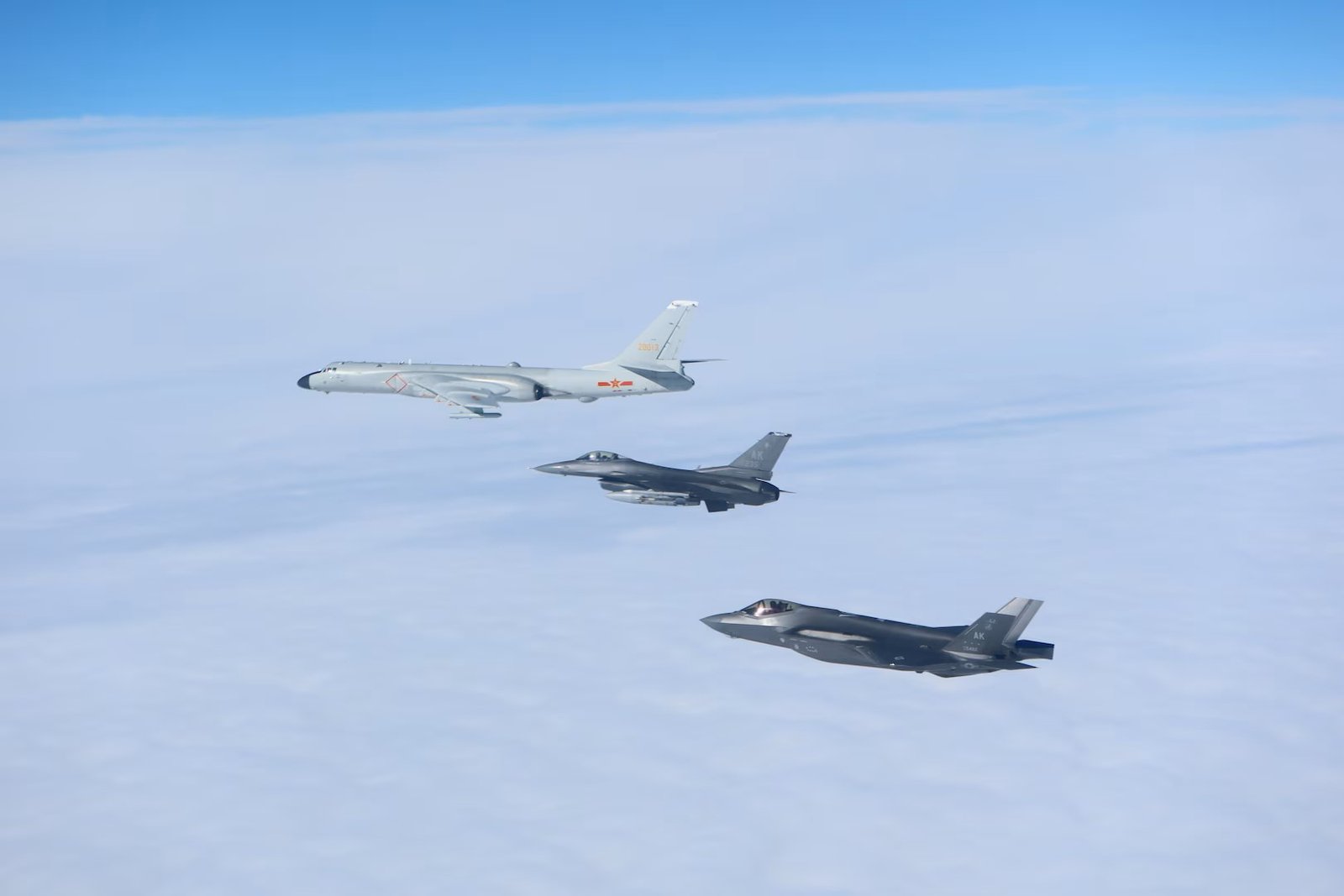


In a show of escalating tensions, Russian military aircraft were detected near the coast of Alaska on Tuesday, prompting a swift response from the U.S. military. The encounter, which involved Russian bombers and reconnaissance planes, was intercepted by American fighter jets but did not breach U.S. or Canadian airspace, according to the North American Aerospace Defense Command (NORAD).
Increased Russian Military Activity NORAD confirmed that it detected and tracked multiple Russian military aircraft operating within the Alaska Air Defense Identification Zone (ADIZ). This area, while not U.S. airspace, is closely monitored as part of national security protocols. NORAD officials stressed that the Russian planes never entered sovereign airspace but highlighted that their presence in the region has become more frequent in recent months.
The intercept involved Russian Tupolev Tu-95 bombers, long-range strategic bombers capable of carrying nuclear weapons, and Il-38 maritime patrol aircraft. These aircraft were met by U.S. Air Force F-22 Raptor fighter jets, which were scrambled from bases in Alaska to escort the Russian planes away from sensitive areas.
Military Response “Russian activity in the North American ADIZ occurs regularly and is not seen as a threat,” NORAD said in a statement. However, it emphasized that the U.S. remains vigilant and prepared to respond to any incursions into North American airspace. The statement underscored NORAD’s mission to safeguard the U.S. and Canadian territories through constant surveillance and quick military responses.
U.S. officials confirmed that no hostile actions were taken during the encounter, and the Russian aircraft eventually returned to their bases. However, the increased frequency of such operations by the Russian military near Alaska has sparked concerns about potential risks and intentions.
Rising Geopolitical Tensions The recent military encounter comes amid growing geopolitical tensions between Russia and the United States. The conflict in Ukraine, ongoing diplomatic strains, and increasing military posturing by both nations have raised concerns about the potential for unintended military clashes. Experts note that while these fly-bys and intercepts are routine, they serve as reminders of the fragile state of U.S.-Russia relations.
In recent years, both Russian and U.S. military forces have ramped up operations in the Arctic, an increasingly contested region due to its strategic importance and untapped resources. The Bering Sea and Arctic Circle, both of which are in close proximity to Alaska, have become focal points for military exercises, with both NATO and Russian forces seeking to assert dominance.
Heightened Surveillance In response to the uptick in Russian activity, NORAD has increased its monitoring of the region. According to the U.S. Department of Defense, these intercepts are meant to send a clear message to Russia that U.S. air defenses remain vigilant and fully capable of responding to potential threats.
As both sides continue to monitor each other’s activities, U.S. military officials reiterated their commitment to protecting North American sovereignty. “We remain ready to defend our homeland at a moment’s notice,” the statement concluded.
With no clear resolution in sight, the world watches closely as Russian military maneuvers continue near U.S. territories, leaving the potential for further escalations.