
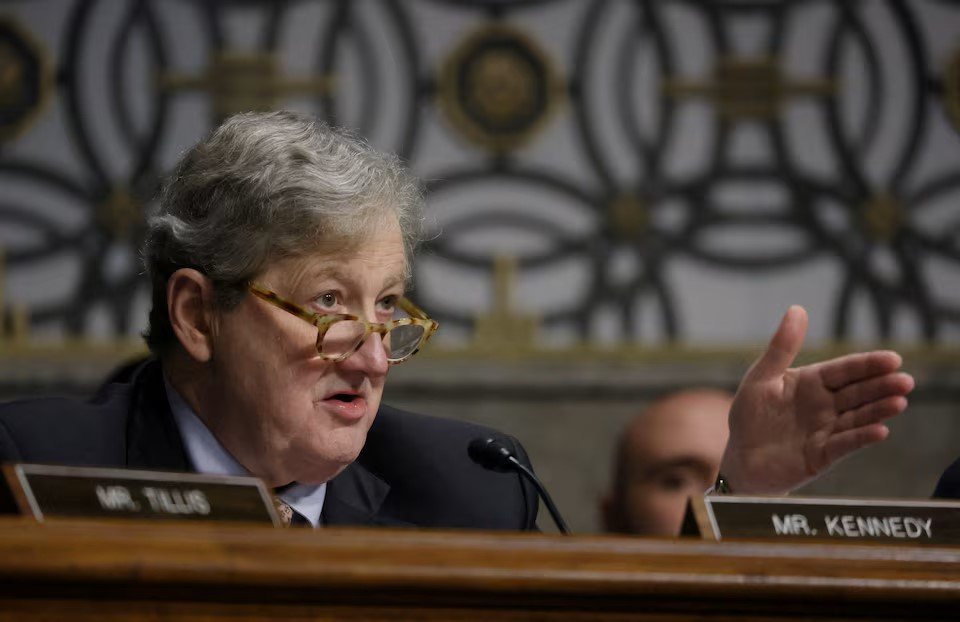


A Senate judiciary hearing on hate crimes took a controversial turn when Republican Senator John Kennedy of Louisiana told Maya Berry, executive director of the Arab American Institute, to “hide your head in a bag.” Kennedy’s remarks came after a heated exchange during which he accused Berry of supporting Hamas and Hezbollah, which she unequivocally denied.
Berry had been invited to testify about hate crimes against Arab Americans, Muslims, and other minority groups. However, the focus of the hearing shifted when Kennedy repeatedly questioned her stance on groups like Hamas, Hezbollah, and Iran. After Berry responded that Hamas is a terrorist organization she does not support, Kennedy pressed further, ultimately making the controversial comment.
The remark drew widespread condemnation from Democrats, civil liberties groups, and Jewish and Muslim organizations. Berry, given the opportunity to respond by committee chair Senator Dick Durbin, expressed her dismay at the hostile exchange. “I’ve experienced the very hate we are here to discuss,” Berry said. “It’s deeply disappointing and indicative of the dangerous polarization we face.”
The hearing also saw disruption when a protester interrupted Senator Ted Cruz’s speech, voicing frustration over the lack of focus on Palestinian casualties in Gaza during the ongoing Israel-Hamas conflict. Cruz countered by accusing the protester of displaying antisemitism.
While Republicans like Senator Lindsey Graham of South Carolina criticized the hearing for what they saw as a diluted focus on antisemitism, Democrats emphasized the need to address all forms of hate, including bigotry against Muslims and Arabs. The Council on American-Islamic Relations (CAIR) and the American Civil Liberties Union (ACLU) strongly condemned Kennedy’s comments, with CAIR calling them an example of the very bigotry Arabs and Muslims face today.
Civil rights organizations, including the National Council of Jewish Women, also denounced the remarks, expressing disappointment at the treatment of Berry, the hearing’s only Muslim witness. They argued that the hearing should have fostered unity against hate rather than perpetuating division.
This incident underscores the deep challenges in addressing hate crimes and fostering civil dialogue in an increasingly polarized political landscape. As hate crimes against various communities rise, the hearing, intended to address these issues, instead highlighted the very divisions it sought to heal.