
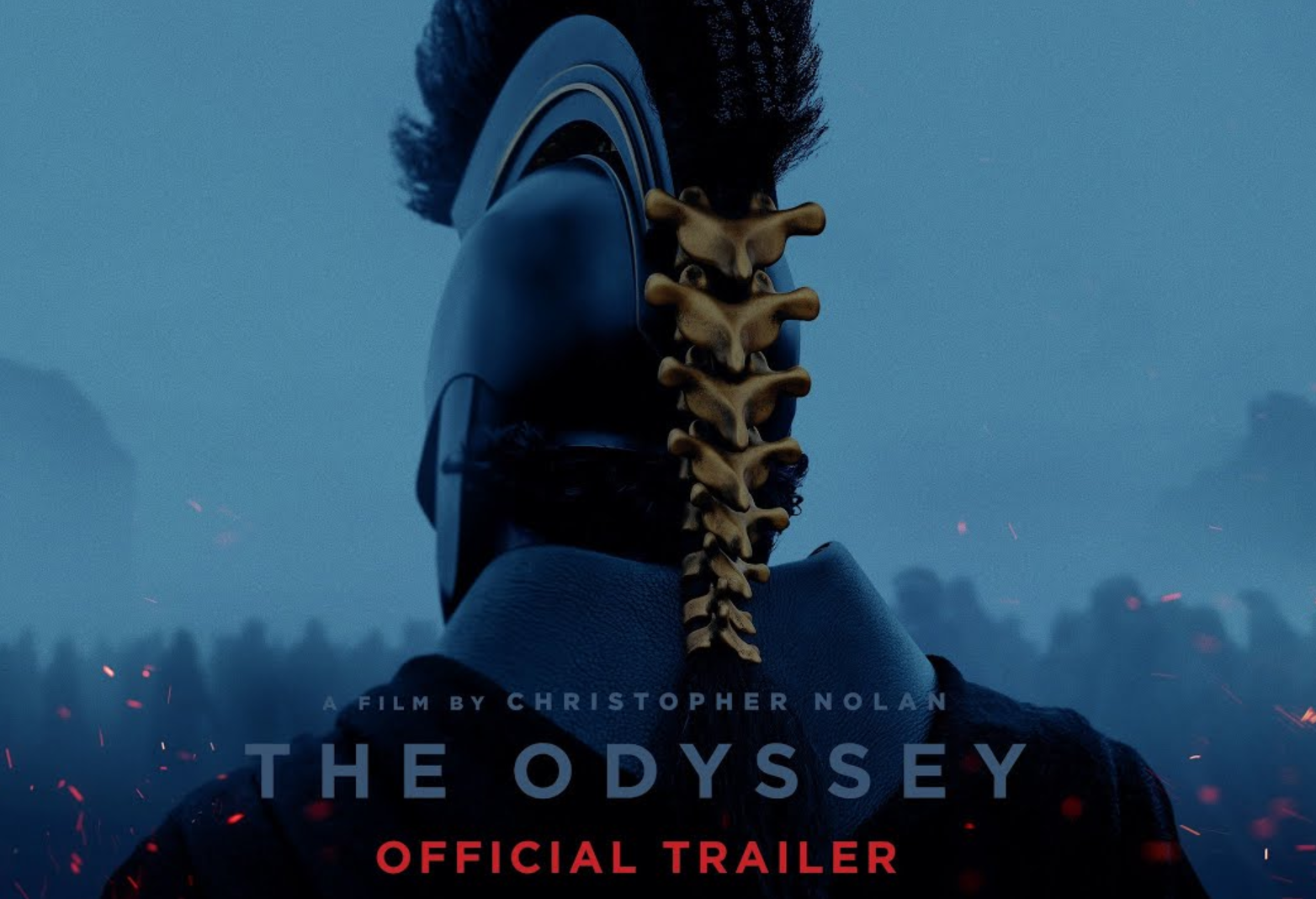


LOS ANGELES — If there were any doubts that Christopher Nolan intends to maintain his position as the fieriest defender of the theatrical experience, the first footage of The Odyssey—released globally by Universal Pictures this Monday (22)—has dispelled them with the force of a tidal wave. Scheduled for release on July 17, 2026, the film marks the director’s first foray into ancient mythology, adapting Homer’s foundational epic with a scale and ferocity that seems to distance itself from the “historical biopic” rigidity of Oppenheimer to embrace the chaotic survivalism of Dunkirk.
The two-minute and thirty-second teaser, which dominated social media conversations and industry analysis throughout Tuesday, offers a glimpse into a production that appears to be both the most expensive of Nolan’s career (estimated at $250 million) and perhaps his most experimental in terms of narrative structure since Memento.
A World of Water and Fury
The preview avoids traditional exposition. Instead, it plunges the viewer directly into the aftermath of the Trojan War. The opening shot is not of a hero, but of a landscape: a vast, unforgiving grey ocean shot on 70mm IMAX film, accompanied by the deafening sound of wind—a sonic signature of Ludwig Göransson, who returns to score the film.
“After years of war, no one could stand between my men and home,” narrates Matt Damon, who takes on the title role of Odysseus. The choice of Damon, an actor capable of projecting both everyman vulnerability and stoic endurance (reminiscent of his role in The Martian), suggests a grounded interpretation of the Greek king. He is not a demigod in this iteration, but a veteran exhausted by slaughter, desperate to reclaim a life that memory is slowly eroding.
The visual language presented is stark. We see the wooden claustrophobia of the Trojan Horse—not as a triumphant strategic marvel, but as a sweating, terrifying waiting room for soldiers. We see the chaotic violence of the sack of Troy, and fleeting, nightmarish glimpses of the obstacles to come: a ship being tossed like a toy by a storm and a terrifying, shadowed sequence in a cave that hints at the Cyclops Polyphemus without fully revealing him. Nolan seems to be treating the monsters of the myth not as fantasy creatures, but as psychological and physical traumas made manifest.
An Ensemble of Survivors
While Damon anchors the film, the trailer confirms the sprawling nature of the cast, a Nolan trademark. Tom Holland appears as Telemachus, Odysseus’s son, in scenes that contrast the high-seas horror with the domestic tension of Ithaca. Holland, sporting a rougher, more mature look, seems to be shedding his blockbuster boyishness to play a young man forced to grow up in a power vacuum.
Anne Hathaway, reuniting with Nolan after The Dark Knight Rises and Interstellar, plays Penelope. The brief shots of her are devoid of the passive “waiting wife” trope; she is shown in sharp focus, navigating the political treachery of suitors with a steely gaze, suggesting the film will give significant weight to the events in Ithaca.
Perhaps the most intriguing casting detail confirmed by the footage and subsequent studio notes is Benny Safdie as Agamemnon. The filmmaker-actor, who delivered a standout performance as Edward Teller in Oppenheimer, appears in full armor, imposing and kingly. His inclusion, alongside Jon Bernthal as Menelaus, points to a heavy focus on the war’s fallout and the fractured leadership of the Greeks. It is a specific flavor of casting—character actors with modern sensibilities placed in ancient settings—that hints at a desire to strip the period piece of its theatrical stiffness.
The supporting cast is equally formidable, with fleeting glimpses or credits confirming Zendaya (Athena), Robert Pattinson (Antinous), and Charlize Theron (Circe). The sheer volume of talent involved suggests a narrative structure that may be episodic or woven with multiple timelines, a technique Nolan has mastered.
Technical Ambition and the “IMAX Event”
Industry analysts are already predicting The Odyssey will be the cinematic event of 2026. Universal Pictures has highlighted that the production was “shot across the world using brand-new IMAX film technology,” purportedly lighter and more versatile cameras developed specifically to capture intimate dialogue scenes and massive action set-pieces with equal fidelity.
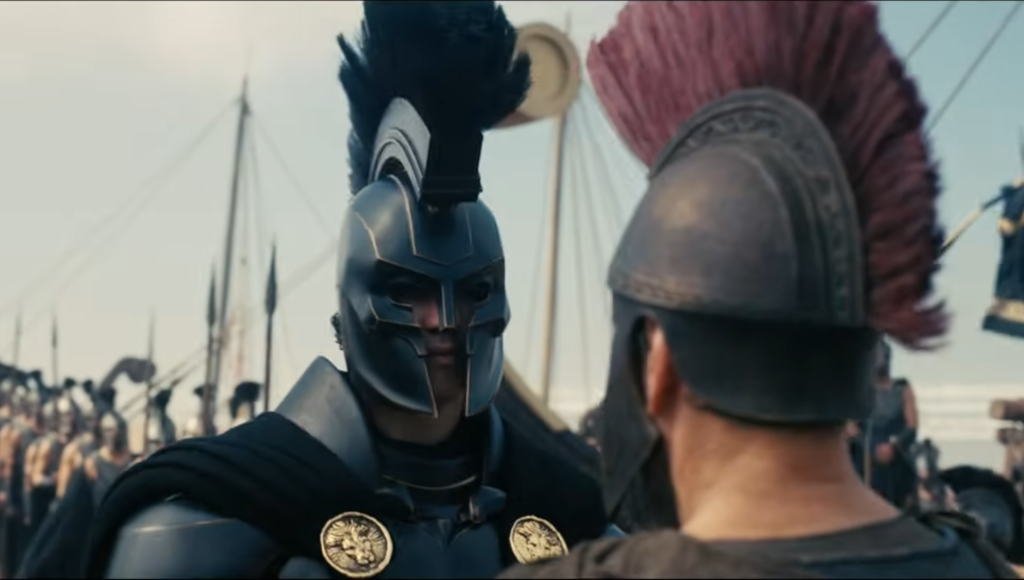
This technical obsession is not merely for marketing. In an era where streaming continues to dilute the cultural impact of cinema, Nolan remains one of the few directors whose name alone guarantees a massive global box office. The footage emphasizes practical effects over CGI; the water, the ships, and the crowds look tangible. There is a weight to the images—a “physicality,” as noted by several critics—that contrasts sharply with the digital sheen of recent Hollywood blockbusters.
The Human Cost of Legend
Thematically, the trailer suggests Nolan is interested in deconstructing the concept of the “hero’s journey.” The tagline revealed at the end, “Defy the Gods,” implies a struggle not just against monsters, but against fate itself.
Drawing parallels to Inception (the desire to return home to one’s children) and Interstellar (the relativity of time and separation), The Odyssey seems poised to explore the cost of time lost. Odysseus’s ten-year voyage is not just a travelogue; it is a gap in a life, a period of estrangement that changes both the traveler and the home he seeks.
“What if I can’t?” Odysseus asks in the trailer’s final moments, responding to a plea to return. It is a moment of doubt that undercuts the certainty of the myth. We know Odysseus returns, but Nolan seems interested in asking: what part of him actually makes it back?
With The Odyssey, Christopher Nolan appears to be challenging himself to adapt a story that has been told for three millennia, yet making it feel urgently contemporary. By grounding the fantastical in the visceral reality of IMAX photography and casting actors known for their psychological depth, he is positioning this film as a study of human endurance.
As the July 17, 2026 release date approaches, the question is no longer whether Nolan can execute a spectacle, but how he will reshape the Western world’s oldest story to fit his distinct obsession with time, memory, and the breaking point of the human spirit. For now, the first footage suggests a journey that will be as exhausting as it is magnificent.