
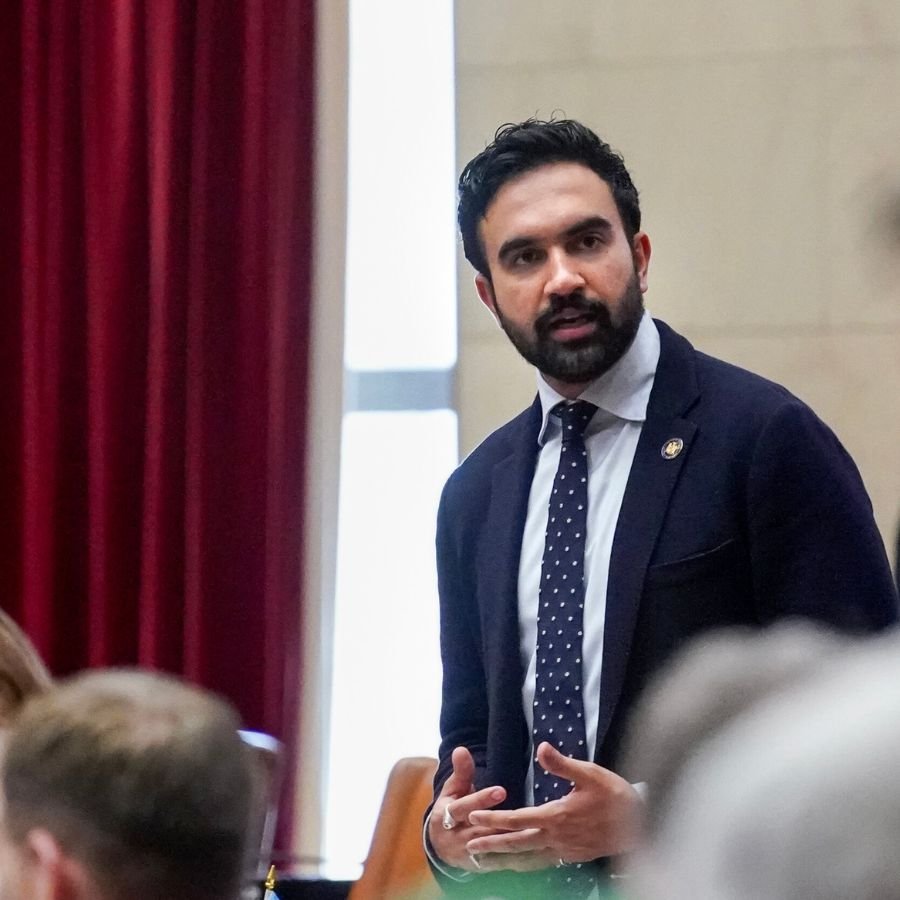


It wasn’t the victory party at a Hilton. It was a sea of soaking-wet twenty-somethings spilling out of a DSA meeting hall in Astoria, their cheers echoing off the brick, the air thick with sweat, hope, and the smell of cheap beer. When the race was finally called by the networks at 11:03 PM on Tuesday, the roar was not just joy; it was disbelief. The “unserious” candidate, the 34-year-old Democratic Socialist rapper-turned-assemblyman, the son of a filmmaker, had not just won. He had conquered.
Zohran Kwame Mamdani, born in Kampala, Uganda, a man who quotes socialist labor leader Eugene Debs more often than any living Democrat, will be the 111th Mayor of New York City. He did it by defeating a specter of New York’s past—former Governor Andrew Cuomo—first in a brutal Democratic primary and again in the general, where Cuomo ran as a defiant independent on a “Save the City” ticket.
Mamdani captured 50.4% of the vote in a three-way race against Cuomo (38.1%) and Republican Curtis Sliwa (10.3%), who seemed to be running a campaign from 1993. The victory, built on a tidal wave of youth turnout (an estimated 78% of voters 18-29) and a consolidation of working-class power in the outer boroughs, marks the most significant generational and ideological rupture in New York politics since the election of John Lindsay in 1965.
The capital of capitalism has just handed its keys to a man who wants to dismantle the master’s house. And now, as a stunned financial elite, a wary Democratic establishment, and a galvanized progressive movement watch, the great, terrifying experiment begins.
The Man from Everywhere
To understand how Zohran Mamdani occupies City Hall, one must first understand that he is a man of profound, almost impossible, contradictions—or, as he would put it, “a true New Yorker.”
He is, at once, the ultimate insider and the ultimate outsider. He is the son of global intellectual and cultural royalty: his mother, the celebrated filmmaker Mira Nair (Salaam Bombay!, Mississippi Masala), and his father, the renowned Ugandan academic Mahmood Mamdani, a leading scholar of post-colonialism. He was born in Kampala, lived in Cape Town, and arrived in New York at age seven, growing up not in the hard-scrabble neighborhoods he now represents, but in the privileged, academic enclave of Morningside Heights. He attended Bronx High School of Science and then Bowdoin College.
“I am fully aware of my privilege,” Mamdani told me during a frantic campaign stop in the Bronx last month, his voice slightly hoarse. He was, as always, dressed not in the mayoral uniform of a navy suit, but in the socialist uniform of a crisp button-down, sleeves rolled up. “My privilege isn’t something to hide. It’s something to use. It means I am here by choice, not by chance. I don’t need this job to be powerful. I need it to give power to the people who actually run this city: the nurses, the teachers, the cab drivers, the bodega workers.”
This, his critics charge, is his most effective sleight of hand: the millionaire’s son cosplaying as a working-class hero. But his supporters see it differently. His background, steeped in his mother’s artistic humanism—her films chronicling the lives of the displaced, the hybrid, the marginalized—is, for them, the very source of his politics.
“Mira Nair taught the world to see the unseen,” said noted cultural critic, Van Jones, in a recent interview. “Zohran wants to govern for them. The question isn’t whether his heart is in the right place—it is. The question is whether he can build a coalition or just a bonfire.”
His identity is a map of global migration: Indian, Ugandan, American, Muslim. He is the city’s first Muslim mayor, a fact that was both a milestone and, in the campaign’s darker moments, a target. But it was his work before politics, as a housing counselor in Queens, that forged his ideology. He wasn’t fighting abstract forces; he was fighting eviction notices, one by one.
“When you see a family’s belongings thrown on a curb,” he said in his acceptance speech, his mother watching from the front row, “you stop believing in the market’s ‘invisible hand.’ You see, very clearly, the hand of the landlord, the hand of the state, and the hand of the system that values property over people. We are here to change that.”
The How: An ‘Unstoppable Force’
Mamdani’s victory was not a fluke. It was the culmination of a decade-long project by the Democratic Socialists of America (DSA) to build power from the ground up, beginning with Alexandria Ocasio-Cortez’s stunning 2018 congressional primary win. Mamdani followed in 2020, toppling a 10-year incumbent for a State Assembly seat in Astoria.
But a mayoral run was a different beast. The Democratic establishment, shattered by Mamdani’s primary victory over Cuomo in June, fundamentally misread the city. They believed his platform was “Twitter-socialism,” a collection of “unserious” proposals that would collapse under the scrutiny of a general election.
They were wrong.
Mamdani’s platform was, if nothing else, specific. He called for a rent freeze on 1 million rent-stabilized units, the creation of a public, city-owned grocery option in each borough to combat food deserts, universal childcare, and perhaps most famously, “Free Buses,” a plan to make all MTA buses fare-free.
“They called free buses a fantasy,” shouted his campaign manager, a 28-year-old DSA organizer, at the victory party. “But for the home health aide in the Bronx who has to choose between a MetroCard and medicine, it’s not a fantasy—it’s a lifeline!”
To pay for it, Mamdani proposed aggressive tax increases on corporations and high-income earners.
The campaign itself was a marvel of modern, grassroots organizing, running circles around Cuomo’s lumbering, big-donor-funded operation. Mamdani’s team suspended fundraising for the primary after hitting the spending cap in record time, fueled by over 180,000 small-dollar donors. While Cuomo held $10,000-a-plate dinners in Midtown, Mamdani’s team—an “unstoppable force,” he called them—was knocking on doors in Fordham, in Sunset Park, in Flushing.
Crucially, they didn’t just talk to Democrats. The campaign’s data-driven field operation made a conscious, and controversial, effort to engage with voters in outer-borough districts that had swung toward Donald Trump in 2020 and 2024.
“The establishment lectures these voters,” a field lead in Queens told me. “We listened. They’re angry about the rent. So are we. They’re angry about grocery prices. So are we. We didn’t canvass on abstract ideas. We canvassed on the material struggles of their lives.”
It worked. Mamdani won the Bronx by 11 points, winning back precincts that had been drifting red.
Cuomo, for his part, ran a campaign of pure, unadulterated fear. He warned that Mamdani’s policies would trigger a “new flight” of the wealthy, gut the city’s tax base, and return New York to the “bad old days” of the 1970s. His independent run, bankrolled by real estate and finance moguls, was a last stand for the transactional, centrist liberalism that has governed New York for a generation.
“Governing is not protesting,” Cuomo said in his concession speech, a warning layered in the congratulations. “You cannot run the world’s most complex city on slogans and anger.”
The Capital of Capitalism vs. The Socialist
The reaction from the city’s financial heart was, to put it mildly, apoplectic.
The night of the primary, billionaire hedge fund manager Bill Ackman posted on X (formerly Twitter) that he was “gravely concerned” and that “hundreds of millions of dollars of capital” were available to back any viable competitor to stop Mamdani, whose policies he warned would be “disastrous.”
Throughout the fall, Ackman, former Mayor Michael Bloomberg, and a constellation of Wall Street PACs poured millions into Cuomo’s independent bid. The Wall Street Journal’s editorial page ran a near-daily drumbeat of warnings. Conservative commentator Ben Shapiro, on his podcast, declared, “New York City has just traded its 401(k) for a copy of The Communist Manifesto. It’s a municipal suicide note.”
Even Washington weighed in. President Donald Trump, from the White House, posted on Truth Social that Mamdani was a “Communist lunatic” and, in a surreal political realignment, urged New Yorkers to “hold their nose” and vote for Andrew Cuomo to block the socialist takeover.
But on Wednesday morning, Ackman’s tone changed. He posted a terse congratulations: “Congrats on the win. Now you have a big responsibility. If I can help NYC, just let me know what I can do.”
The city’s business establishment, which had openly ridiculed Ackman’s olive branch as a “pathetic white flag,” now faces a choice: fight, flee, or find a way to work with a mayor who openly calls them “the owning class.”
Mamdani, for his part, seems unfazed. His transition team, already being announced, is a who’s who of progressive academics, labor organizers, and public-interest lawyers. There is not a single real estate lobbyist or investment banker in sight.
“This is not New York liberalism,” a senior Mamdani advisor told me. “Liberalism, from de Blasio to Adams, believes in taxing the rich to fund social programs—a ‘Tale of Two Cities’ that they try to manage. We don’t want to manage the two cities. We want to end the tale. We believe in public power, public goods, and public ownership.”
It is a vision that sounds less like Bill de Blasio and more like Eugene Debs, the American socialist who ran for president five times, once from a prison cell. It is an ideology that, until Tuesday, was relegated to history books and campus reading groups. Today, it is the governing mandate for the most important city in the world.
The Experiment
New York has always been a city of pendulum swings, lurching from one era to the next. We have seen the “order” of Rudolph Giuliani, the technocratic, corporate management of Michael Bloomberg, the “progressive” promises and managerial failures of Bill de Basiio, and the swaggering, uneven tenure of Eric Adams.
Zohran Mamdani is not a swing of that pendulum. He is an attempt to break the clock.
He inherits a city still grappling with the post-COVID “new normal,” a housing crisis that has become a humanitarian disaster, a public transit system bleeding money, and a deeply fractured social contract.
The forces arrayed against him are monumental: a skeptical (and hostile) business community, a furious police union, a centrist Democratic governor in Albany, and a Republican administration in Washington.
Can he actually govern? Can he implement a rent freeze without collapsing the housing market? Can he fund free buses without bankrupting the MTA? Can a self-described “socialist” manage the world’s most complex, capitalist city?
Or will he be a one-term mayor, a historical asterisk, the “Lindsay of the Left,” whose idealistic ambitions crash against the hard, unyielding realities of municipal power?
As his supporters chanted his name into the rainy Queens night, Mamdani ended his speech with a quote not from Marx, but from his mother, Mira Nair. “She taught me,” he said, his voice cracking with emotion, “that if we don’t tell our own stories, no one else will.
“Tonight,” he declared, “the tenants, the drivers, the cooks, and the cleaners—we have begun to tell our own story. And it is the story of a new New York.”
The city, and the world, is watching. The story is just beginning.