
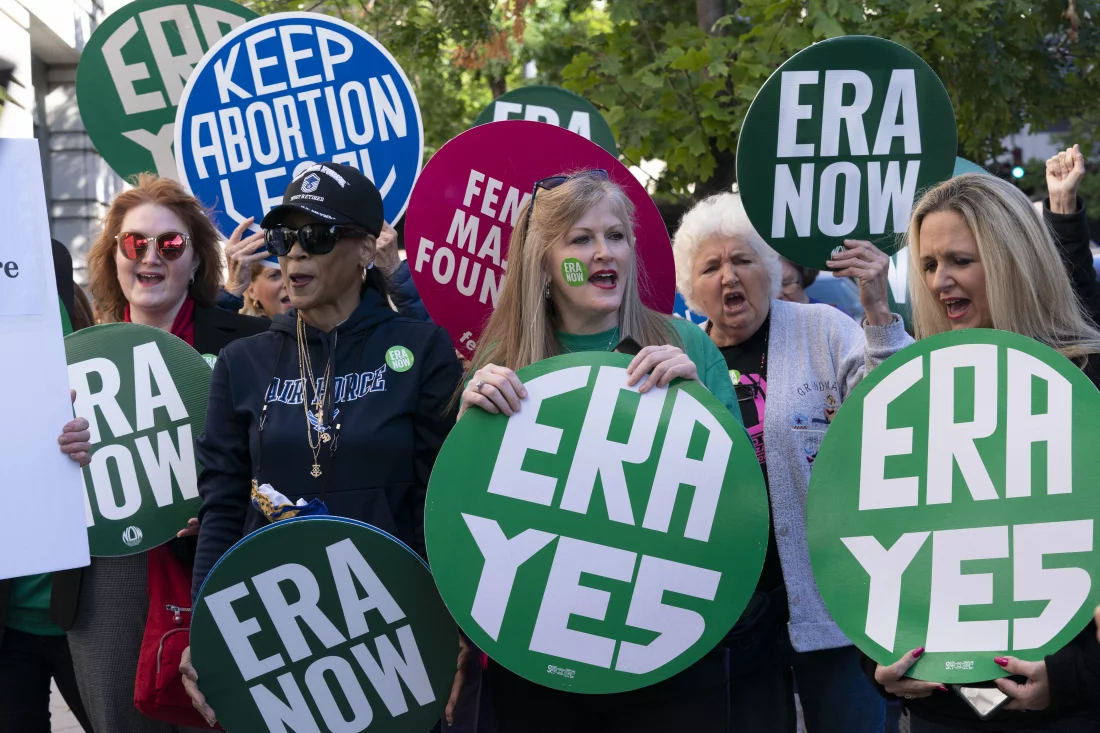


President Joe Biden made a surprising declaration on Friday, stating that he considers the Equal Rights Amendment (ERA) to the Constitution as “the law of the land.” While the statement holds no formal legal power, it has energized supporters of the amendment, many of whom gathered in front of the National Archives to advocate for its formal recognition.
The ERA, aimed at guaranteeing equal legal rights regardless of sex, has faced decades of political and legal hurdles since its introduction. Biden’s remarks have added new momentum to the ongoing debate over its status, though significant questions remain about its implementation.
The Role of the National Archivist
For the ERA to take effect, it must be officially published or certified by National Archivist Colleen Shogan. However, the timeline for such action remains uncertain. The White House clarified that Biden will not direct Shogan to certify the amendment, as her role is “purely ministerial,” meaning she is only required to publish the amendment once it is ratified according to legal standards.
The executive branch does not have a direct role in the constitutional amendment process, further complicating Biden’s statement. Legal experts have pointed out that without formal certification, the ERA cannot yet be enforced as part of the Constitution.
Supporters Celebrate, Critics Question
Backers of the ERA have lauded Biden’s declaration as a symbolic victory, calling it a step toward achieving long-overdue gender equality in the legal system. Eleanor Smeal, a prominent women’s rights activist, said, “This is a historic acknowledgment from the president, but it’s just the beginning. We need concrete action to make the ERA a reality.”
Critics, however, argue that Biden’s statement is premature and potentially misleading. Opponents of the amendment have raised procedural concerns, pointing out that the original deadline for state ratification expired in 1982. While three more states ratified the ERA in recent years, bringing the total to the required 38, legal disputes over the expired deadline have left its status in limbo.
Legal Challenges Loom
The primary legal hurdle revolves around whether Congress has the authority to extend or remove the ratification deadline retroactively. Advocates argue that the deadline should not invalidate the amendment, while opponents claim that any further action would require starting the ratification process from scratch.
Federal courts have already heard cases related to the ERA, but no definitive ruling has been issued. Some legal scholars believe the matter will ultimately be decided by the Supreme Court, a process that could take years.
Political Implications
Biden’s statement has also drawn attention to the broader issue of gender equality and its role in the upcoming elections. By vocalizing support for the ERA, Biden may be seeking to galvanize his base, particularly women and younger voters, who overwhelmingly favor the amendment.
Meanwhile, Republican lawmakers have largely dismissed the push for the ERA, framing it as a political maneuver rather than a legal necessity. Senator Mitch McConnell called Biden’s remarks “an empty gesture with no legal foundation.”
What’s Next?
The path forward for the ERA remains uncertain. Supporters plan to intensify their advocacy efforts, calling on Congress to take steps to remove the deadline and urging the National Archivist to act. Biden’s declaration, while symbolic, has reignited the debate and put the issue back in the national spotlight.
Whether the ERA will ultimately become enforceable law depends on the resolution of legal disputes and political will. For now, the amendment’s future hangs in the balance, awaiting decisive action from both lawmakers and the courts.